
%20(1).png)
Beetle Bump 2: brownfield habitat creation comes to Barking Riverside
- Mar 31, 2017
- 3 min read
Brownfield habitat creation guidelines developed in TURAS have been rolled out at Barking Riverside to help conserve a rare beetle.
Following the successful creation of a Beetle Bump at the University of East London Docklands Campus as part of TURAS, Beetle Bump 2 has now been created at the TURAS case study site of Barking Riverside.
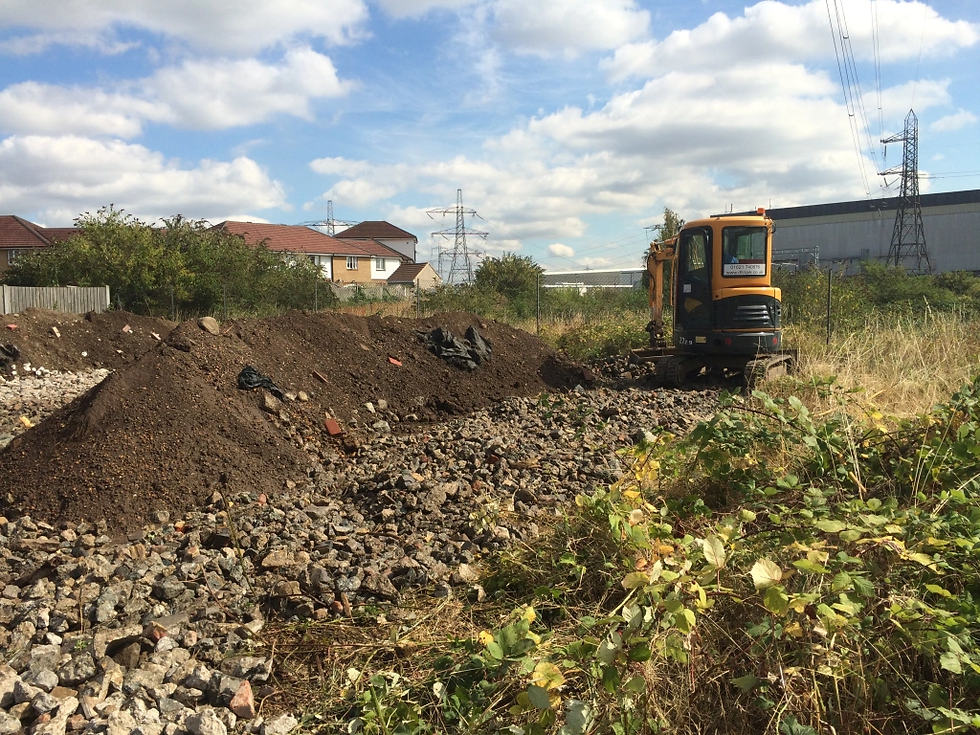
1) Rubble soil mound creation as part of the Beetle Bump at Barking Riverside © Jessica McDermott
The nationally rare streaked bombardier beetle (Brachinus sclopeta) has turned up again on a post-industrial site in the East Thames Corridor, in London, UK. Again it is on a site earmarked for major development and again it was in need of rescuing in an attempt to save the population. University of East London Sustainability Research Institute staff helped searching for and rescuing the beetles from the site prior to development . As part of the mitigation programme, ABP London provided the funding for the creation of a new Beetle Bump habitat on which the streaked bombardier beetles could be released. TURAS partners, Barking Riverside Ltd, kindly agreed to donate a parcel of land on their development site to house the second Beetle Bump as part of their ongoing programme of habitat creation for brownfield biodiversity.

2) Streaked bombardier beetle (Brachinus sclopeta) © Stuart Connop – Sustainability Research Institute (UEL)
Construction of the new Beetle Bump has now been completed. This involved bringing an excavator on site to scrape off the existing topsoil, buddleia and bramble, to create a compacted hardcore/soil base. Onto this base crushed hardcore/concrete was laid out, then two long east-west piles were created using screened topsoil, gabion stone and 40-70mm gravel. Small amounts of chalk were incorporate into the mounds, as well as two areas of chalk laid out, to diversify the habitats on the site and to attempt to recreate the calcareous grassland conditions that some of the streaked bombardiers’ prey are thought to be associated with. Following construction of the mounds, wildflower seed was hand sown to kick-start the vegetation colonisation. This included black medick (Medicago lupulina), purple toadflax (Linaria purpurea), tufted vetch (Vicia cracca), weld (Reseda luteola), oxeye daisy (Leucanthemum vulgare), teasel (Dipsacus fullonum) and common bird’s-foot trefoil (Lotus corniculatus). A particular focus was placed on black medick seeding as there is some anecdotal evidence that streaked bombardiers seemed to be associated with the black medick areas at the donor site, especially where it was developing on compacted hardcore.

3) Seeding and washing the seed into the mounds © Jessica McDermott
Created at the western boundary of the Ripple Road nature reserve, the second beetle bump forms a natural extension of the reserve adding to the mosaic of habitats already found on the site. The rescued streaked bombardiers have now been released into their new home and it is hoped that this brownfield extension to the reserve will support a sustainable population of the beetles. If it does, it will create an important new source for the East Thames Corridor metapopulation of the species. The new site will also be a beneficial habitat addition for many of the species associated with the Barking Riverside brownfield site pre-development and it will provide an opportunity for local residents to experience national conservation priority species on their own doorstep and to get involved in conservation habitat management.

4) The original Beetle Bump at UEL © Stuart Connop – Sustainability Research Institute (UEL)


Comments